Tuesday, 30 October 2018

The end of the tunnel


A friend in Spain asked me to describe my life in hospital. You might find it interesting. You might not!
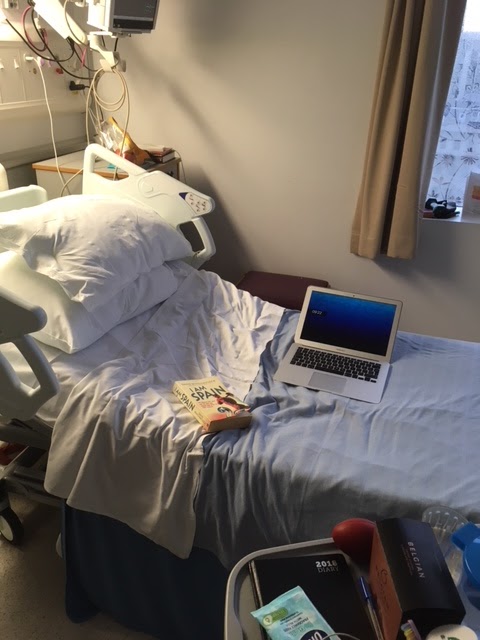
I can see the end of this tunnel now and hope to be home in ten days / two weeks. I have now been in hospital for 6 weeks and such a long stay has an interesting effect on you. You become ‘institutionalised’. By that I mean you construct ways of getting through the days and weeks. In my case I walk 30 ward rounds each day, a corridor that encircles all the rooms on my ward. 150 paces, so I divide it into three blocks of ten. 10 early in the morning, 10 in the afternoon and 10 in the evening. I plan the first at soon after 7am which means I walk past the breakfast caterer as she is preparing her trolley. This means I get given an extra early morning cup of tea! It also means I get known for this activity with the result that the doctors have stopped insisting I have the anti-coagulant injection at 5 pm. A sharp stab in the stomach which I hated. Of course the hospital have their routines. Drip-feed drugs fed to my arm feed every four hours, night and day. Blood pressure and temperature every 4 hours, Echocardiogram at 6 am every morning - and so on. Then there are the unexpected. The orderly turning up to take me to X-ray, cardiac tests I hadn’t been told about and so on. Of course I get to know all the staff well and we laugh and joke quite a bit. Visits from medical students etc. Then my visitors. Most days I have friends / relatives visit me and Anne Aylor most days. She and they bring me real food as the stuff they give you here would put you in hospital if you weren’t here already! When left alone I read - at the moment a great book on the Spanish civil war, listen to music and chat with my neighbour - right now an Angolan geologist. But since I am long-term, they come and go and I am like the older relative, inducting them into useful secrets, e.g. how to get an early morning cup of tea. Of course my ‘bed-blogs’ - my stories on life in hospital which are all on my website - one or two now published on internet sites. Finally regular physio exercises. My stroke weaknesses are getting better, but my left hand is still numb and weak and I cannot play guitar. I have one here. This is the one late-in-life talent I am most proud of so my objective is that I WILL play it again, just not yet.

song. Dire Straits Tunnel of Love 

Friday, 26 October 2018

Getting Better


When you have been in hospital for a month you learn a lot about the other patients and about the NHS staff. Here are some examples. The nurse who is always smiling, always ready with a joke and comforting words. When I comment on this I learn that her husband died when he returned to their African home to get work and rebuild a future for his wife and two sons to return to. The low paid Serco worker who gives me an early morning cup of tea, whose half-day is seven and a half hours and full day is eleven and a half. The nurse who wakes me every morning to do the daily ECG. She is always singing and when I ask her why she is so cheerful answers, 'what choice do we have?' The doctor who is part of the Consultant morning visit team who sees I am upset by the news I am given and who returns to my bedside after they have moved on to offer me reassurance. The patient who, uninvited, sits beside me to tell me about his army days in Malaya. Can't stand his Empire memories, but when he turns to his love of gardening he becomes human again. Mohammed who keeps me awake all night with his involuntary dream-screams. The next morning he apologises and we go together to the nurses desk to ask for a solution to help both of us. He is moved to his own room. A dear man and I hope he recovers because he has been too ill. As for me I'm now getting better


Thursday, 25 October 2018

Throw away food


A friend attended a lecture at The Welcome Institute last week and was told that Serco hospital food (see my earlier blog) is cooked in Wales, is then frozen and transported across the country to the company’s franchises. The food is then reheated and ’served’. The culinary destinations include not just hospitals, but the military, prisons, asylum-seeker holding centres and not forgetting the Flyingdales early warning facility. A third to a half of all this food is thrown away. The bread today was clearly toasted in Cardiff. No aspersions on Serco staff who are kind, caring and doing their best on their poverty wages. The Serco CEO on his £850,000 annual salary is doing best of all. 


song: Food glorious food

Wednesday, 24 October 2018

hot water bottles & fans


A new, low-carbon combined cooling, heating and power solution has been created for St Bartholomew’s Hospital in London as part of the first fully-financed PFI deal of its kind.
Delivered by Skanska, the project is part of Sustainable Development Capital‘s (SDCL) Powering Health collaboration with GE, Clarke Energy and the NHS Confederation.
Under the deal SDCL has provided finance for Skanska to deliver a low-carbon combined chilling/heating and power (CCHP) solution at the hospital. The £2.5m investment will be made by the UK Energy Efficiency Investments Fund, which has launched a £50m fund supported by the Green Investment Bank.”
Sounds great. I have been a patient at Barts hospital for a month and was a patient here in February, and neither the heating nor the air-conditioning have worked. My bed faces the west and on sunny days gets very hot. And it's autumn. A nurse told me that during the long hot summer this year the temperature on south and west-facing sides was 'unbearable' for both patients and staff. In winter, she said, it was so cold at night, they were handing out 4/5 blankets to each patient.
How can a medical institution of such excellence, with such a dedicated staff, all of whom I now admire and adore, mess things up when it comes to the simple problems of temperature and nutrition?
Answers from Skanska and Serco please. I am ill and cannot continue this struggle. Maybe others can.
Meanwhile these two photos show my solution for this hospital over the coming years.
I'm afraid I feel very depressed about all this right now so here is another Leonard Cohen to help you join me.


Friday, 19 October 2018

Scapegoats


"When a goat likes a book, the whole book is gone.”

I need a scapegoat and in my case it is the goat. The microbiology lab here at Barts hospital has concluded that the bug which got into my heart valve – the bovine (cow) valve which was fitted here in February, is of the Equine Streptococcal strain. So we have cows, horses and now, my theory albeit unbacked by evidence – goats. I spent a month last summer with my Bosnian family at their home outside Mostar. After I met Anne on the Croatian island of Mljet I picked up a virus which lasted until my stroke five weeks ago. There were no horses on the island but the lab has said that other animals share 99% of their DNA.
There are goats in the area, some of them once owned by the family we stay with. See Anne Aylor's film about their goats here,  (at 4.10 mins) But that was some years ago and the goats have long since taken themselves up into the surrounding woods and hills. 
But back in Mostar there are goats-a-plenty. They are on the hillside at the end of Oha and Masa Maslo's garden where I stay when I am there. (Oha is Director of Mostar Rock School) Twice a day a goat-herder walks his animals slowly across my eyes. I hear their bells before I see them emerge from the trees onto the sage-covered rocks. Even when I can't see them I hear their bells as I sit on the terrace which faces onto a garden full of cherry, pomegranate, figs and walnut trees. Wildflowers in the nearby field attract Cleopatra butterflies, Plain Tigers and a profusion of Simple Whites. Bees from Masa's hives buzz in and out from the sage bushes the goats feed from. The hill rises up to Mount Velez and we seem to be at the base of a bowl, in a hidden valley which induces a feeling of remoteness, peace and isolation.
Of course this is all an illusion. The herder is a refugee from central Bosnia, eking out a subsistence living with the help of his animals. The hillside is still peppered with mines. The wildflowers in that field are there because the family who owned the land fled when the area was under bombardment.
I see and hear the goats, but's that's it. But the two Maslo dogs are free-range and spend time on the hillside. For sure they must tread through goat detritus. Lovely dogs, they jump up to greet me whenever possible and it is possible that they brought me the streptococcal. 
But are the goats to blame for my hospital stay? Of course not. I am to blame for not building up my immune system after the February operation. I won't make the same mistake again. I have been told that the Russian military developed Neuropeptide Bioregulators that are great as immune builders. So I will move east of the Balkans and seek help from the Russians. Then it will be back to sitting on the Maslo terrace, waiting for the goats.

Here's a goat refusing to be a scapegoat